
GREAT FORGOTTEN MOTORCYCLES–2004 KTM 625SXC; THE WRAP

I recently stumbled on a post on thumpertalk.com. A guy was asking about a 2004 KTM 625SXC he saw for sale; if he should buy it, was it any good and so on. No one replied. It was if the SXC was redacted from the files of motorcycle history.
I remember that bike well. Back in 2004, KTM was on fire (in a good way). The bikes were good, business was booming, and the Austrian company had established itself as the premier brand in the off-road world. One of the cornerstones of all that was the new RFC four-strokes, which were built on the old Husaberg platform. The 625SXC, on the other hand, was built on the old LC-4 platform which was widely considered outdated at the time. The LC-4 first arrived in 1987, when a “liquid-cooled four-stroke” was something special. It was hard to start, heavy, ill-handling and unremarkable in most ways. But it got a little better every year. Over 16 years, that added up to a lot better.

It turned out that the new four-strokes in the KTM line were the best things that could have happened to the LC-4. Suddenly, it was no longer expected to be a lightweight race bike. It was liberated to become something much more appropriate; we’ll call it a dirt cruiser. It grew a battery and an electric starter and the price fell into XR territory. That’s pretty amazing considering that the bike probably cost more to manufacture than KTM’s new four-strokes. And even more amazing when you consider that international exchange rates had the dollar at an all-time low versus the euro. The bottom line was that KTM is taking a bit of a beating with the SXC in order to get it established in its new role.

The motor was still a liquid-cooled, four-valve thumper with a wet sump design and a five-speed gearbox. It was still 625cc in actual displacement. It used older WP suspension components and was the only KTM with rear shock linkage. That’s right, no PDS, no twin-piston shock; just good old fashioned linkage. We don’t know if that made it a KTM from the past or the future.
One very significant addition was the Mikuni CV carb. The bike already complied with the emissions requirements for a California green sticker and probably wasn’t far from street specs of the time. Combine that with the keyed ignition and we could smell dual sport all over the bike.

In the test that appeared in the August 2004 issue of Dirt Bike, we said the KTM’s power was just like the Honda XR650R of the day. That’s saying something. Today, the mighty XR650R has ascended to hallowed status. There are riders who collect them just for parts, claiming that there is nothing equivalent today. It was all about torque. You could virtually idle up steep hills and all it took was a slight twist of throttle to bust out crazy acceleration. It wasn’t much of a revver, but it still made power at 8500 rpm. There was just no real incentive to scream the motor when it was so much fun down low. Outside of the XR, there was no other bike that compared for this type of torque; not the KTM 525EXC, not any of the 450s, not even a Kawasaki KX500–which was still around. The XR650R and the SXC were two of a kind, but the KTM had an electric starter whereas the Honda could be a beast to start. The KTM even had a kickstarter if the battery was dead. It worked fairly easily if you got the hang of having it on the left. Remember, this motor was straight out of the ‘80s. Euro motors were all backwards back then. The starter’s on the left and the countershaft sprocket was on the right. That started a chain reaction of backwards parts; the ignition and the rear brake were different from the more modern parts that run on the other KTMs back then.

The 625SXC had a short lifespan. In 2007, the first fuel-injected 690 arrived, and although it still carried the LC4 name, it was completely different. It continued to evolve and eventually became today’s 690 Enduro. I’ll admit, most of the bikes that I remember fondly from long ago are disappointments to revisit. Even then, I complained about the 625’s vibration. But, as long as I don’t run across a cheap one in good condition, I’m probably safe. I’ll continue to enjoy it in my memory without complaint.
KTM’s FIRST BANKRUPTCY AND TOM MOEN

Tom Moen retired from KTM recently after 40 years. I’ve know him that entire time–his job changed over the years, but he was usually in charge of dealing with the press. One of the many things that told you about his character was how be behaved the first time KTM went bankrupt. “The Monday after Thanksgiving in 1991, Rod Bush called up and gave us some advice,” remembers Scot Harden. “He said if you have any personal stuff in the office, take it home. There might be a lock on the door tomorrow.” Rod was the president of KTM America, which was a wholly owned subsidiary of KTM Austria, and he knew that something was going down. KTM’s U.S. headquarters was in Ohio and a small western sales office was manned by a handful of guys including Scot, Sel Narayana and Tom Moen. Sure enough, most of the KTM staff was furloughed immediately.
In Austria, the company had overproduced bicycles by the thousands and KTM’s fledgling radiator manufacturing business had proven to be a massive drain. But, if you looked at the company’s motorcycle business–specifically the U.S. branch–it wasn’t doing too poorly. In fact, the U.S. distributorship had money in the bank, motorcycles in the warehouse and a growing network of dealers. All that was enough to interest financial investor Stefan Pierer in the company’s potential. He had been peripherally involved with KTM through a personal relationship with ‘94/‘95 World Motocross Champion Heinz Kinigadner. Pierer had a history of working with distressed businesses and had been instrumental in saving the Kinigadner family bakery. He knew that if KTM could survive in the short term, long-term prospects were good.
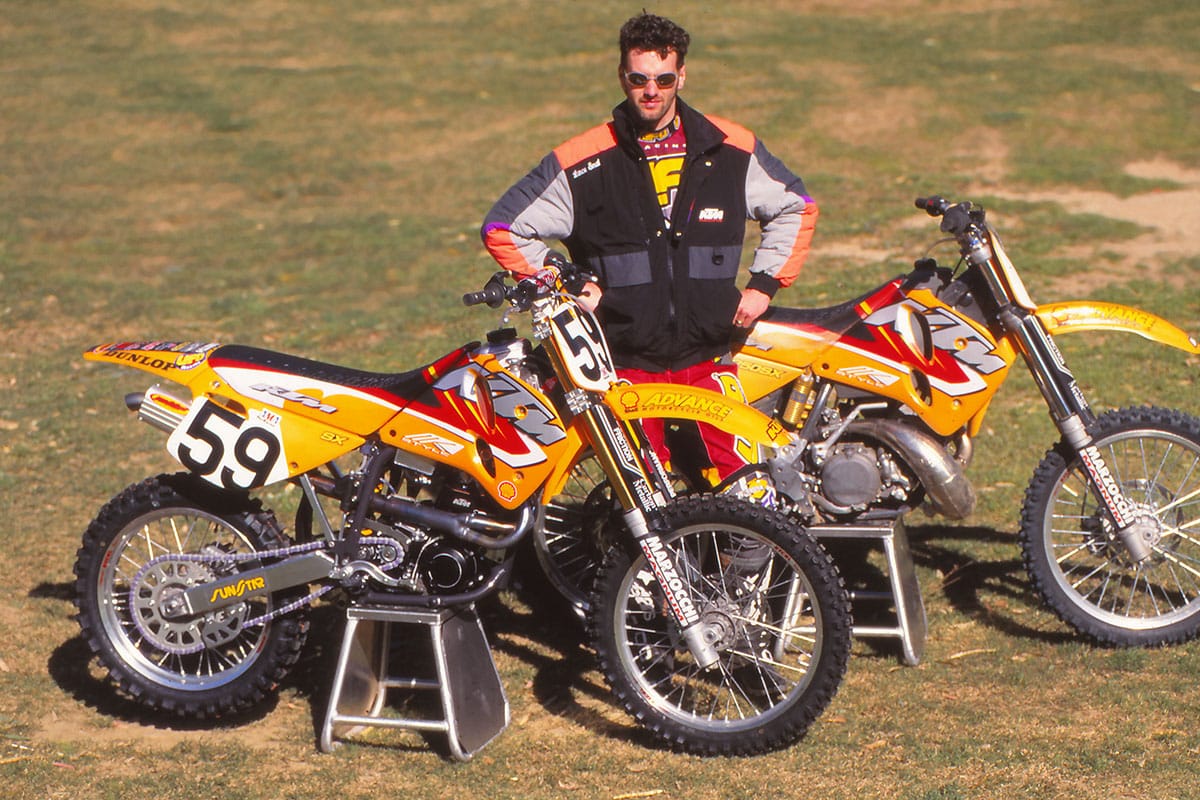
Tom Moen was one of the furloughed employees. Between December 1991 and March 1992 he was unemployed. But he was still needed, so he showed up at work every day. In that time period, Pierer worked his financial magic using mostly funds from the U.S. subsidiary for leverage, so in a manner, Tom and a few other truly faithful employees saved KTM. In the following years, Tom’s main function was in the marketing department but he almost always had a project of passion on the side. One of those was building Lance Smail’s 538cc LC-4, which became the first four-stroke to qualify for a premier class Supercross main event. Smail finished 28th in the 1997 Daytona Supercross. Tom Moen saw the company through two bankruptcies as well as years of wild success and dozens of championships. Congratulations Tom!
See you next time!


Comments are closed.